
T: +86-186-8927-7942
E: kemp@hangjin-machinery.com
E: kemp@hangjin-machinery.com
No. 107 Changning Road, Tongjing Town, Jiangning District, Nanjing, Jiangsu, China
Views: 0 Author: Site Editor Publish Time: 2026-08-13 Origin: Site


The operational impact of blade geometry directly dictates production speed, material yield, and edge finish across all industrial cutting applications. The choice between rotational and linear cutting mechanisms forms the foundation of manufacturing efficiency. Misaligned tooling creates hidden operational costs. Using the wrong blade type leads to excessive kerf waste, premature tool wear, thermal damage to materials, and severe production bottlenecks.
Evaluating a circular blade vs straight blade requires a strict technical analysis of mechanical action, material compatibility, and scalability. This assessment guides final procurement and tooling decisions. Operations must align the blade's physical characteristics with the specific demands of the material, whether processing delicate textiles, heavy steel extrusions, or reinforced concrete.
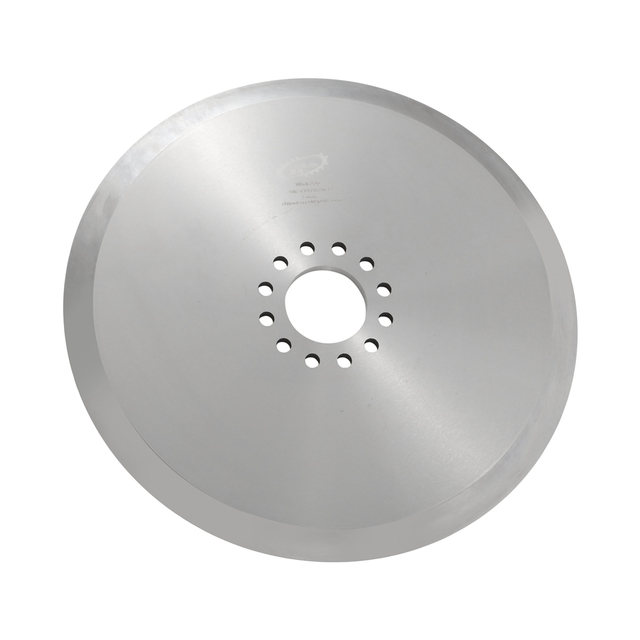
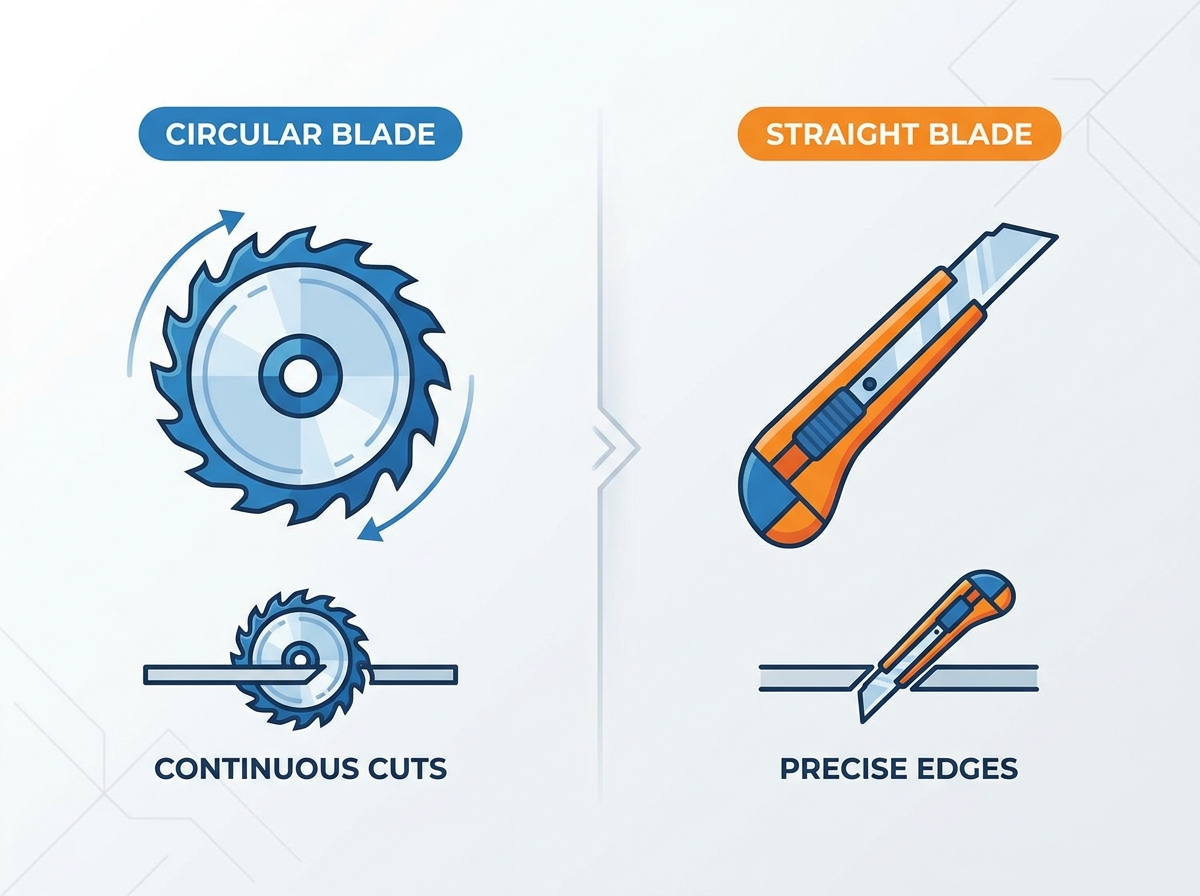
Mechanical Action Dictates Throughput: Circular blades utilize continuous rotational motion for high-speed, high-volume cuts, while straight blades rely on reciprocating, shearing, or guillotine actions for precise slicing, chopping, and intricate detail work.
Material and Application Specificity: Circular blades dominate in continuous ripping, cross-cutting, automated extrusion, and concrete cutting; straight blades excel in packaging, textiles, tight-radius detail work, and low-dust shearing.
Geometry and Wear Dynamics: Rotational friction in circular blades requires specific tooth counts (e.g., 16-40 for ripping) and deep gullets for heat dissipation. Straight blades rely on specific TPI (Teeth Per Inch) configurations, up-cut, or skip-tooth designs, often facing localized wear that requires frequent honing or replacement.
Investment and ROI: The initial investment in circular blade systems is generally higher, but they offer superior ROI in high-throughput environments due to longer intervals between sharpening and faster cycle times.
Table of Contents
Circular blades operate on rotational mechanics, providing continuous engagement of teeth or a continuous beveled edge against the workpiece. This rotary action allows the cutting edge to enter and exit the material at high velocities, driven by the spindle RPM of the machinery. The continuous motion ensures that the cutting force remains constant, preventing the stuttering or stalling often associated with interrupted cutting methods. When you push material through a table saw or a cold saw, the blade maintains a relentless, unidirectional force.
Centrifugal force plays a massive role in the performance of circular blades. As the blade spins, this force actively ejects chips, sawdust, and metal swarf away from the cutting zone. Gullet depth—the valley between each tooth—is engineered specifically to facilitate this material removal. Deep gullets capture large volumes of waste material and carry it out of the kerf before heat can build up. If gullets are too shallow for the material being cut, the blade will pack with debris. We see this frequently when operators try to rip wet lumber with a crosscut blade; the result is extreme friction, thermal warping, and potential catastrophic failure of the blade plate.
Tooth count dynamics further define the blade's mechanical capability. Lower tooth counts, typically ranging from 16 to 40 teeth on a standard 10-inch blade, are designed for aggressive ripping operations. These blades take larger bites of material per revolution, prioritizing speed over surface finish. They also feature a positive hook angle, which aggressively pulls the material into the blade. Conversely, high tooth counts (60 to 100+ teeth) are utilized for smooth cross-cutting. The higher number of teeth means each tooth removes a microscopic amount of material, leaving a glass-smooth finish but requiring a slower feed rate. The primary advantage of the circular mechanism remains its uninterrupted cutting action, allowing operators and automated feeders to push material through the cutting zone rapidly and continuously.
Straight blades operate on linear mechanics, which manifest in three primary formats: reciprocating (found in jigsaws, reciprocating saws, and scroll saws), guillotine (utilized in sheet metal shears and industrial presses), or continuous linear (characteristic of band saws). Unlike the rotational entry of a circular blade, straight blades engage the material in a straight line, either pushing through the substrate or slicing across it. This linear approach changes how the tool interacts with the material's grain or structural matrix.
The cutting action relies heavily on the specific geometry of the edge. For toothed straight blades, performance is dictated by TPI (Teeth Per Inch). A low TPI indicates large teeth spaced far apart, ideal for aggressive, rough cuts in thick materials like framing lumber or heavy PVC. A high TPI indicates fine teeth packed closely together, necessary for cutting thin metals or plastics without tearing the material. Specialized configurations like up-cut teeth pull the material toward the machine shoe for stability, while skip-tooth designs provide extra chip clearance for thick, soft materials. Guillotine blades feature a continuous, toothless beveled edge designed to shear material under immense hydraulic or mechanical pressure.
The primary advantage of straight blades lies in their maneuverability and precision. Reciprocating straight blades can execute plunge cuts directly into the center of a panel, a task impossible for a standard circular blade without a specialized track saw setup. They also navigate tight radii and intricate scrollwork effortlessly. Guillotine straight blades offer the distinct advantage of clean shears with absolutely zero kerf, meaning no material is converted into waste dust during the cutting process. This eliminates the rotational tear-out and splintering frequently associated with circular saw blades.
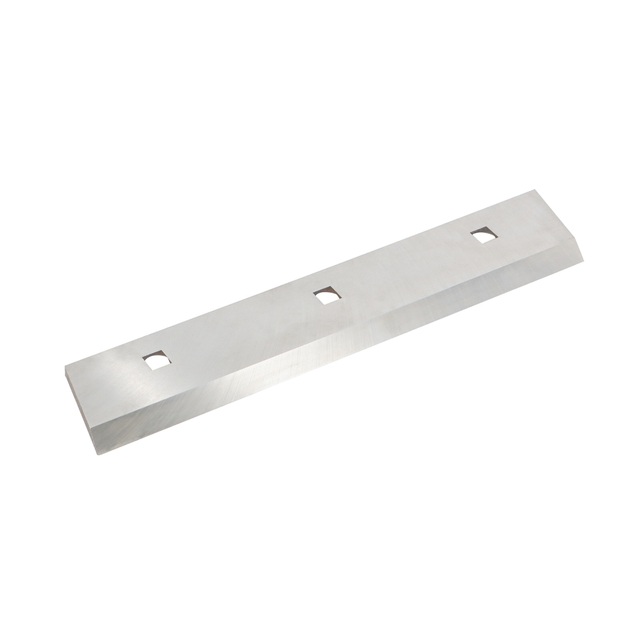
Cycle times differ drastically between the two blade types. Circular blades offer superior linear cutting speeds, making them the industry standard for long, uninterrupted runs. In a sawmill or a high-volume panel processing plant, a circular blade can rip hundreds of feet of material per minute. The continuous rotation means there is zero wasted motion; every fraction of a second is spent actively removing material. You simply cannot match this linear footage output with a reciprocating tool.
Straight blades face mechanical limitations in high-volume linear cutting due to stroke recovery time. In reciprocating saws, the blade must stop and reverse direction at the end of every stroke. This non-cutting return stroke halves the theoretical cutting efficiency. However, in automated stamping and shearing presses, straight blades achieve massive throughput in a different way. A guillotine shear can slice a 10-foot sheet of steel in a single, instantaneous stroke, vastly outpacing the time it would take a circular cold saw to traverse the same distance.
Kerf width directly impacts material yield, especially when processing high-value substrates like exotic woods, aerospace-grade aluminum, or specialized polymers. Circular blades typically possess a wider kerf. The steel plate must be thick enough to resist warping under high RPMs, and the carbide or diamond teeth must be wider than the plate to prevent binding. This means every cut converts a 1/8-inch to 3/16-inch strip of material into waste. Over thousands of cuts, this lost yield represents a significant financial drain on the operation.
Edge finish relies heavily on operator technique and blade geometry. Circular blades prevent tear-out when equipped with the correct tooth grind, such as an Alternate Top Bevel (ATB) for wood or a Triple Chip Grind (TCG) for metals. Achieving perfectly straight cuts freehand with a circular saw requires exceptional operator skill. Industrial precision relies on heavy guide tracks or automated CNC fences. Straight blades in guillotine setups guarantee absolute linear precision. Because they shear rather than mill the material, they operate with near-zero kerf, preserving 100% of the material yield.
Thermal dynamics dictate the lifespan of any cutting tool. Circular blades generate significant friction due to their continuous engagement and high RPMs. This heat transfers directly into the steel blade body. To combat thermal expansion, high-quality circular blades feature laser-cut expansion slots. These engineered gaps allow the steel to expand as it heats up without warping or distorting the blade's tension. Without adequate cooling mechanisms, circular blades will burn the material and lose their temper, leading to a wobbling blade that destroys the cut quality.
Maintenance cycles vary based on the blade architecture. Multi-tooth carbide circular blades require professional sharpening. The sharpening process involves grinding each individual carbide tooth to restore the precise cutting angles, a process that can be repeated several times before the blade must be discarded. Straight blades, particularly reciprocating ones, often suffer from localized wear. Only the section of the blade actively engaging the material becomes dull. While some large guillotine blades can be honed and shimmed, smaller straight blades are typically treated as consumable items and replaced entirely when dull.
Blade Geometry and Performance Comparison
Feature | Circular Blades | Straight Blades |
|---|---|---|
Motion Type | Continuous Rotational | Linear / Reciprocating / Shearing |
Kerf Width | Moderate to Wide (Material loss) | Zero to Narrow (High yield) |
Speed / Throughput | Extremely high for continuous linear runs | High for single-stroke shears; slower for reciprocating |
Heat Generation | High friction; requires expansion slots | Lower friction; heat dissipates during return stroke |
Maintenance | Professional sharpening of individual teeth | Honing (guillotine) or complete replacement |
In the woodworking sector, circular blades handle the heavy dimensioning. Ripping rough lumber requires blades with 16 to 40 teeth and deep gullets to clear long, stringy wood fibers without bogging down the table saw. Cross-cutting veneered panels or melamine demands blades with 60 to 80 teeth featuring a steep ATB grind to slice the fragile surface fibers cleanly. Flat top grinds are utilized specifically for cutting flat-bottomed joinery grooves. Using the wrong grind here will result in blown-out edges and ruined stock.
Straight blades take over when the geometry of the part becomes complex. Scroll work requires highly specialized straight blades. Skip-tooth blades provide aggressive material removal for large sweeping curves, while fine-tooth up-cut blades navigate tight radii without stalling. Reciprocating straight blades are the standard for flush cutting dowels, executing detail joinery in hard-to-reach corners, and aggressive structural demolition where nails and screws may be embedded in the wood.
Metal fabrication demands strict adherence to RPM and feed rate protocols. Circular uses include cold saws and abrasive chop saws. Cold saws run at very low RPMs, utilizing high-speed steel (HSS) or carbide-tipped circular blades to mill through heavy steel beams and aluminum extrusions. These blades rely on a TCG grind, where a trapezoidal tooth does the heavy roughing and a flat tooth cleans the cut, ensuring extreme durability against hard metals. Flood coolant is mandatory here to prevent the chips from welding back onto the blade.
Straight blades dominate sheet metal processing. Guillotine shears drop massive straight blades under hydraulic pressure to snap sheet metal cleanly without generating heat or metal dust. In on-site fabrication, reciprocating blades equipped with bi-metal construction and high TPI counts are used for pipe fitting, cutting conduit, and modifying structural brackets where bringing the material to a stationary circular saw is impossible. The flexibility of a bi-metal straight blade allows it to bend flush against a wall without snapping.
Cutting concrete requires abrasive or grinding action rather than traditional milling. Circular blades used in this sector are embedded with industrial diamond segments. These blades excel at scoring concrete slabs, trenching asphalt for utility lines, and cutting masonry blocks. The rotational speed combined with water cooling allows the diamonds to grind through aggregate and rebar simultaneously. If you cut dry for too long, the metal matrix holding the diamonds will melt over the stones, glazing the blade and rendering it useless until it is dressed with an abrasive block.
Straight blades in masonry are reserved for localized, precision demolition. Heavy-duty reciprocating masonry blades, often coated in carbide grit or featuring large carbide inserts, allow operators to make plunge cuts into brick walls for window installations. They fit into tight structural spaces where a large circular concrete saw cannot safely operate. These blades take a massive beating and require a heavy-duty saw with a long stroke length to clear the masonry dust effectively.
Processing plastics and textiles requires strict thermal management. Circular blades are highly effective for slitting continuous webs of paper or thin plastic film. These razor-sharp, toothless circular blades slice the material as it rolls past at high speeds, relying on the tension of the web to ensure a clean cut. Any burr on these blades will cause the web to tear, shutting down the entire production line.
Straight blades are the absolute standard for die-cutting and chopping packaging materials. In textile manufacturing, rotational friction from a toothed circular blade will instantly melt synthetic fibers, ruining the edge. Straight shearing blades slice through stacks of fabric cleanly, avoiding the friction-induced melting that plagues high-speed rotational cutting. Guillotine-style straight blades are also used to chop thick rubber and foam where a spinning blade would simply bind and stall.
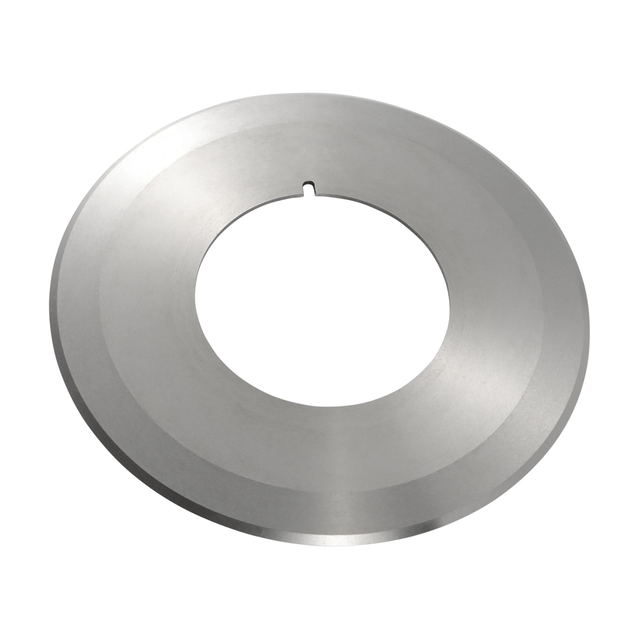
Selecting the correct blade requires mapping the metallurgical composition and geometry to the expected outcome. High-Speed Steel (HSS) blades offer excellent sharpness but lose their edge quickly on abrasive materials. Carbide-tipped blades provide exceptional hardness, extending lifespan significantly when cutting hardwoods or non-ferrous metals. Diamond-tipped blades are mandatory for masonry and highly abrasive composites. Geometry dictates the finish: total tooth count and gullet depth govern the smoothness and speed of circular blades, while TPI and stroke length control the aggression and finish of straight blades.
Modern manufacturing relies on automation. Circular blades integrate seamlessly into CNC machinery, automated panel saws, and continuous feed lines. The continuous rotation allows optical sensors and automated pushers to feed material at a constant rate without pausing for blade reset. Straight blades integrate differently. They are the core components of automated stamping presses, shearing machines, and robotic slicing arms. A guillotine press can be synchronized with a coil feeder to stamp out hundreds of identical metal blanks per minute, a level of discrete part production that circular blades cannot match.
Determining the financial viability of a tooling upgrade requires a strict calculation of investment and return. The framework involves adding the initial blade cost to the frequency of sharpening or replacement, factoring in machine downtime during blade changes, and calculating the financial loss of material waste due to kerf. Operations must identify the breakeven point. Upgrading to a highly specialized, expensive carbide circular blade system often outweighs the lower initial cost of consumable straight blades when the operation runs high-throughput, continuous lines where downtime and kerf waste destroy profit margins.
The most common implementation risk is mismatching the blade to the machinery. Installing a circular blade with an incorrect arbor size will cause catastrophic vibration and immediate machine damage. Exceeding the maximum RPM rating of a circular blade can cause the steel plate to fracture, turning carbide teeth into lethal projectiles. For straight blades, mismatching the stroke length or shank type leads to blade pull-out and snapped steel.
Mitigation requires strict verification of OEM specifications. Operators must follow a rigid setup protocol to ensure safety and accuracy:
Verify the arbor size of the machine matches the bore size of the circular blade exactly. Never use loose reducer bushings on high-RPM equipment.
Check the machine's maximum RPM against the blade's stamped RPM limit. The machine RPM must never exceed the blade's rating.
Inspect the blade flanges and arbor nut for debris. A single wood chip trapped behind the flange will cause severe blade runout.
For straight blades in band saws, apply the correct tension using the machine's built-in gauge to prevent blade wander.
Ensure the teeth are facing the correct direction for the machine's rotation or stroke path.
Rotational and linear cutting mechanisms present entirely different safety hazards. Circular blades present severe kickback risks. If the material pinches the back of the spinning blade, the rotational force will violently eject the workpiece back toward the operator. Straight blades present pinch point hazards and the risk of the blade snapping under heavy compression loads, sending sharp shrapnel into the workspace.
Mitigation strategies must be engineered into the workflow. Circular saw operations require the installation of riving knives to keep the kerf open and anti-kickback pawls to grip the material. Guillotine and reciprocating setups require heavy physical guarding to keep operator hands out of the shear zone. All operations must strictly adhere to OSHA and ISO safety standards for industrial cutting equipment, including mandatory lockout/tagout procedures during blade changes.
The choice between a circular blade and a straight blade is not a matter of one being universally superior. Success depends entirely on aligning the mechanical action of the tool with the material's thermal tolerance, density, and the operation's throughput requirements. Misapplication leads to ruined material, broken machinery, and compromised safety. Operations should default to circular blades for continuous, high-speed, straight-line production. Conversely, straight blades are the mandatory choice for low-kerf slicing, navigating tight curves, shearing flexible textiles, or executing plunge cuts in tight spaces.
As an industry leader in precision industrial tooling, Hangjin combines decades of advanced manufacturing expertise with state-of-the-art metallurgical engineering to deliver custom cutting solutions. Whether you require high-durability circular saw blades for heavy-duty production lines or precision straight blades engineered for specialized applications, Hangjin provides premium, high-performance tooling tailored to optimize your production efficiency and minimize material waste.
To optimize your cutting operations, take the following steps:
Audit your current scrap rates to determine exactly how much material is lost to kerf waste each month.
Consult with a tooling engineer to review the specific thermal and density properties of your primary materials.
Request a blade sample to conduct a controlled pilot run on your shop floor.
Measure cycle times and edge finish during the pilot run before committing to a facility-wide tooling overhaul.
A: The primary difference is the mechanical motion. Circular blades use continuous rotation for high-speed, uninterrupted cutting, which generates more heat and a wider kerf. Straight blades rely on linear, reciprocating, or shearing actions. This makes straight blades ideal for precise slicing, tight curves, and zero-kerf cuts without causing rotational tear-out on the material.
A: Circular blades are the industry standard for long, straight rips when paired with guide tracks or heavy fences. However, straight blades mounted in a heavy-duty guillotine setup offer perfectly straight, instantaneous shears with zero material loss. This makes guillotine straight blades superior for processing sheet metal, paper, and textiles.
A: While highly skilled operators can execute straight cuts freehand by carefully following a scribed line, industrial precision cannot rely on freehand techniques. Achieving perfectly straight, repeatable cuts in a production environment strictly requires guide rails, automated tracks, or robust table fences to prevent blade binding and material waste.
A: Tooth count refers to the total number of teeth around the entire circumference of a circular blade, such as a 24-tooth ripping blade. TPI stands for Teeth Per Inch. We use TPI to measure the tooth density of straight blades. TPI dictates the smoothness, speed, and aggression of the linear stroke.
A: Yes. Circular blades mill the material. They turn a 1/8-inch to 3/16-inch path, known as the kerf, into sawdust or metal chips. Many straight blades, particularly guillotine shears and slicing knives, push through the material with zero kerf. This results in absolutely no wasted material during the cut.
A: Choose a low tooth count, typically 16 to 40 teeth, with deep gullets for fast, aggressive ripping along the grain. Select a high tooth count, ranging from 60 to over 100 teeth, for smooth, clean cross-cutting across the grain. High tooth counts are also mandatory when processing delicate materials like veneered plywood and melamine.


