
T: +86-186-8927-7942
E: kemp@hangjin-machinery.com
E: kemp@hangjin-machinery.com
No. 107 Changning Road, Tongjing Town, Jiangning District, Nanjing, Jiangsu, China
Views: 0 Author: Site Editor Publish Time: 2026-08-13 Origin: Site


Improper blade selection carries heavy penalties on the manufacturing floor. You see excessive material waste piling up near the machines. You experience frequent downtime as operators constantly swap out dull tooling. Compromised product quality follows, leading to rejected batches and wasted labor. Many operators treat blade selection as an afterthought to machine capability. This is a mistake.
Understanding how to choose industrial blades requires treating the process as a complex engineering decision. You must align material science, machine dynamics, project scope, and edge geometry. A mismatched blade destroys materials and damages equipment. The cutting tool is the direct point of contact with your product. Its design dictates the success of the entire operation.
We use a systematic, evidence-based framework to solve this problem. You will learn to evaluate substrate characteristics, metallurgy, machine specifications, and industry compliance. This approach eliminates guesswork and optimizes your cutting process for maximum efficiency and precision.
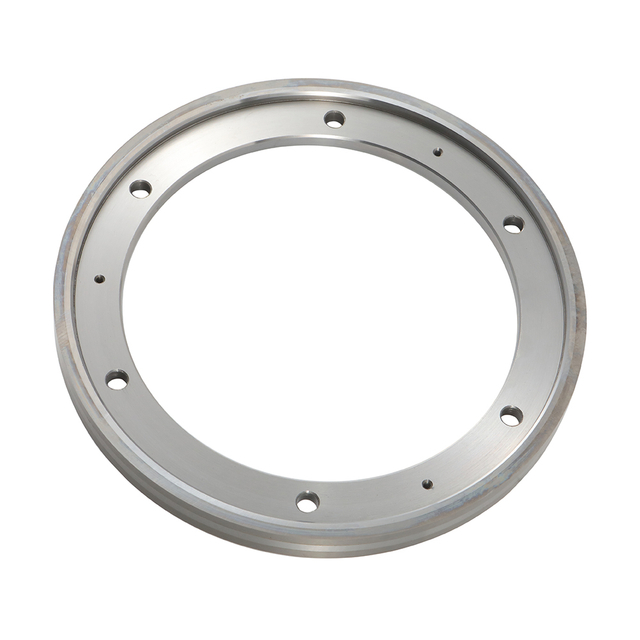
Material Dictates Metallurgy: The substrate being cut (its hardness, abrasiveness, and thermal sensitivity) is the primary baseline for selecting blade steel grade and surface coatings.
Geometry Determines Quality: Tooth pitch, gullet capacity, bevel angles, and kerf directly control cut finish, feed speed, and heat dissipation.
Machine Constraints are Absolute: Operating parameters such as RPM, feed rates, and mounting tolerances strictly limit viable blade options.
Table of Contents
The physical properties of your target material dictate the baseline requirements for your cutting tool. Tensile strength and material density directly influence the cutting force required to sever the substrate. When processing high-tensile steel, the blade must possess exceptional structural rigidity to resist deformation under massive shear forces. You cannot use a standard carbon steel blade on 4140 chromoly; the edge will roll over immediately.
Conversely, cutting low-density materials like corrugated cardboard requires a completely different approach. Cardboard demands an ultra-sharp, thin edge to slice cleanly through the fibers without crushing the internal flutes. Substrate density alters the mechanics of the cut. High-density materials resist penetration. They require blades with robust edge profiles and higher Rockwell hardness (HRC) ratings. If you use a blade designed for soft plastics on dense vulcanized rubber, the edge will chip. You must match the blade's hardness to the material's density to ensure the cutting edge penetrates the substrate efficiently without deflecting.
Abrasive materials destroy standard steel blades rapidly. Substrates like fiberglass, carbon fiber, and glass-filled plastics act like sandpaper against the cutting edge. These materials accelerate edge wear through continuous micro-abrasion. To combat this, you must specify wear-resistant alloys or specialized carbide compositions that can withstand the abrasive onslaught without losing their geometry.
Thermal dynamics play an equally significant role on the shop floor. The friction generated during a high-speed cut produces intense heat. This heat transfers into both the blade and the substrate. If you cut heat-sensitive materials like thermoplastics, excessive friction will melt the plastic directly onto the blade body. This causes galling, ruins the cut finish, and eventually binds the machine. Similarly, cutting dense hardwoods at incorrect feed rates can burn the wood and ruin the temper of a standard steel blade. You must select blade geometries and coatings that actively dissipate heat to protect both the tool and the product.
The broader project scope often imposes strict design constraints on your tooling. Industrial cutting is rarely just about severing material. It is about meeting regulatory and quality standards. In food processing and pharmaceutical manufacturing, hygiene is non-negotiable. You must use FDA-approved stainless steels, such as 420 or 440C. These grades resist corrosion and withstand harsh chemical washdowns without degrading.
Aerospace and medical device manufacturing require adherence to strict ISO-certified tolerances. Blades used in these sectors must feature exact dimensional accuracy to ensure the final product meets rigid engineering specifications. A blade with even microscopic runout or structural inconsistencies will produce parts that fail quality control. You must verify that your blade manufacturer operates under stringent quality management systems to guarantee compliance with your industry's specific regulations.
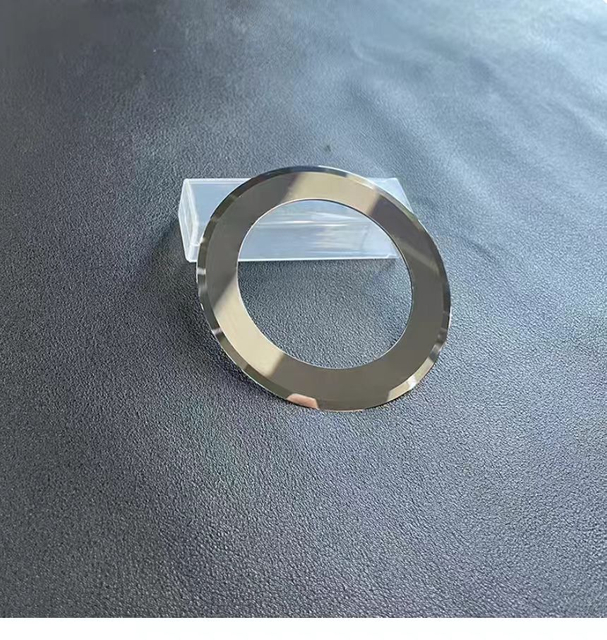
Straight blades dominate applications requiring linear cutting motions. These tools excel in guillotining, slicing, and shearing operations. Guillotine blades drop vertically to sever stacks of paper, sheet metal, or textiles in a single stroke. Slicing blades utilize a sliding motion to cut cleanly through soft or sticky materials without compressing them.
The structural requirements for straight blades vary wildly based on the application. High-impact shearing operations, such as cutting thick steel plates, demand thick, heavily tempered blades capable of absorbing massive shock loads without fracturing. Precision slicing, such as portioning food products or cutting thin polymer films, requires a razor-thin profile with a highly polished bevel to minimize friction and ensure a pristine edge finish.
When setting up a straight shear blade, operators must follow specific alignment procedures:
Clean the mounting surfaces entirely to remove debris that could cause misalignment.
Seat the blade firmly against the backstop before tightening the mounting bolts.
Adjust the blade clearance gap according to the thickness of the material being sheared.
Perform a test cut on scrap material to verify edge alignment and cut quality.
Continuous processing lines rely heavily on circular knives and rotary slitting blades. These tools process endless webs of paper, foil, textiles, and metal coils. The continuous rotational motion allows for high-speed production without the start-stop interruptions of straight blade cycling.
Rotary slitting utilizes three primary mechanisms. Crush cut slitting forces a blunt-edged circular blade against a hardened anvil roller, physically separating the material through pressure. This works well for non-woven fabrics and certain papers. Shear cut slitting uses two overlapping circular blades acting like a pair of scissors. This method provides the cleanest edge for paper, foil, and thin metals. Razor slitting pulls the material web past a stationary or freely rotating razor blade, offering a highly efficient solution for thin plastic films and tapes.
Rotary Slitting Mechanisms Comparison
Slitting Method | Mechanism Description | Best Suited Materials | Primary Limitation |
|---|---|---|---|
Crush Cut | Blunt blade presses against a hardened anvil roller. | Non-wovens, thick paper, rubber. | Produces a slightly compressed or dusty edge. |
Shear Cut | Two overlapping blades create a scissor-like action. | Foil, thin metals, high-quality paper. | Requires precise alignment and tensioning. |
Razor Slitting | Web is pulled across a stationary or free-spinning razor. | Thin plastic films, adhesive tapes. | Blades wear quickly and require frequent changes. |
Band saw blades consist of a continuous loop of toothed metal driven by rotating wheels. They handle irregular shapes, thick substrates, and continuous heavy-duty cutting tasks. Band saws are indispensable in metal fabrication, timber milling, and meat processing.
Blade width dictates the band saw's cutting capability. Narrower blades excel at cutting the tightest curves and intricate contours. They maneuver easily through the substrate but lack the beam strength for long, straight cuts. Wider blades provide the rigidity needed for perfectly straight, stable cuts through thick, dense materials. You must balance the need for maneuverability against the requirement for structural stability when selecting band saw blade width.
High Carbon Steel (HCS) provides a highly flexible solution for low-speed, low-heat cutting applications. The high carbon content allows the blade to take a remarkably sharp edge. However, HCS loses its temper and softens rapidly if exposed to high temperatures. It serves well for cutting wood, plastics, and softer non-ferrous metals where heat generation remains minimal.
High-Speed Steel (HSS) incorporates alloying elements like tungsten, molybdenum, and vanadium. Common grades like M2 HSS offer excellent red-hardness. These additions allow HSS to retain its hardness and structural integrity at significantly higher temperatures than HCS. HSS blades withstand the intense heat generated during metalworking and high-speed machining operations. HSS delivers vastly superior performance and longevity in demanding industrial environments.
Tungsten Carbide represents a massive leap in wear resistance. Manufactured through powder metallurgy, carbide blades feature extreme density and hardness. They effortlessly cut highly abrasive materials like fiberglass, carbon fiber composites, and high-pressure laminates. Carbide maintains its edge exponentially longer than standard steel.
However, you must manage the trade-off between edge retention and shock resistance. Both Tungsten Carbide and advanced ceramics (like zirconia) are inherently brittle. They excel in stable, continuous cutting environments but fail catastrophically under heavy shock loads or interrupted cuts. Ceramics offer the added benefit of being chemically inert, making them ideal for medical and food processing applications where metallic contamination is strictly prohibited.
Applying specialized coatings to the blade surface drastically alters its performance characteristics. Titanium Nitride (TiN) is a popular physical vapor deposition (PVD) coating that adds a microscopic layer of extreme hardness to the blade. TiN reduces friction, protects the underlying steel from abrasive wear, and extends the operational lifespan of the tool.
Polytetrafluoroethylene (PTFE), commonly known as Teflon, provides exceptional non-stick properties. PTFE coatings prevent material adhesion when cutting sticky substrates like adhesives, rubber, or resin-heavy woods. By preventing galling and material buildup on the blade body, coatings ensure consistent cut quality and reduce the energy required to drive the blade through the material.
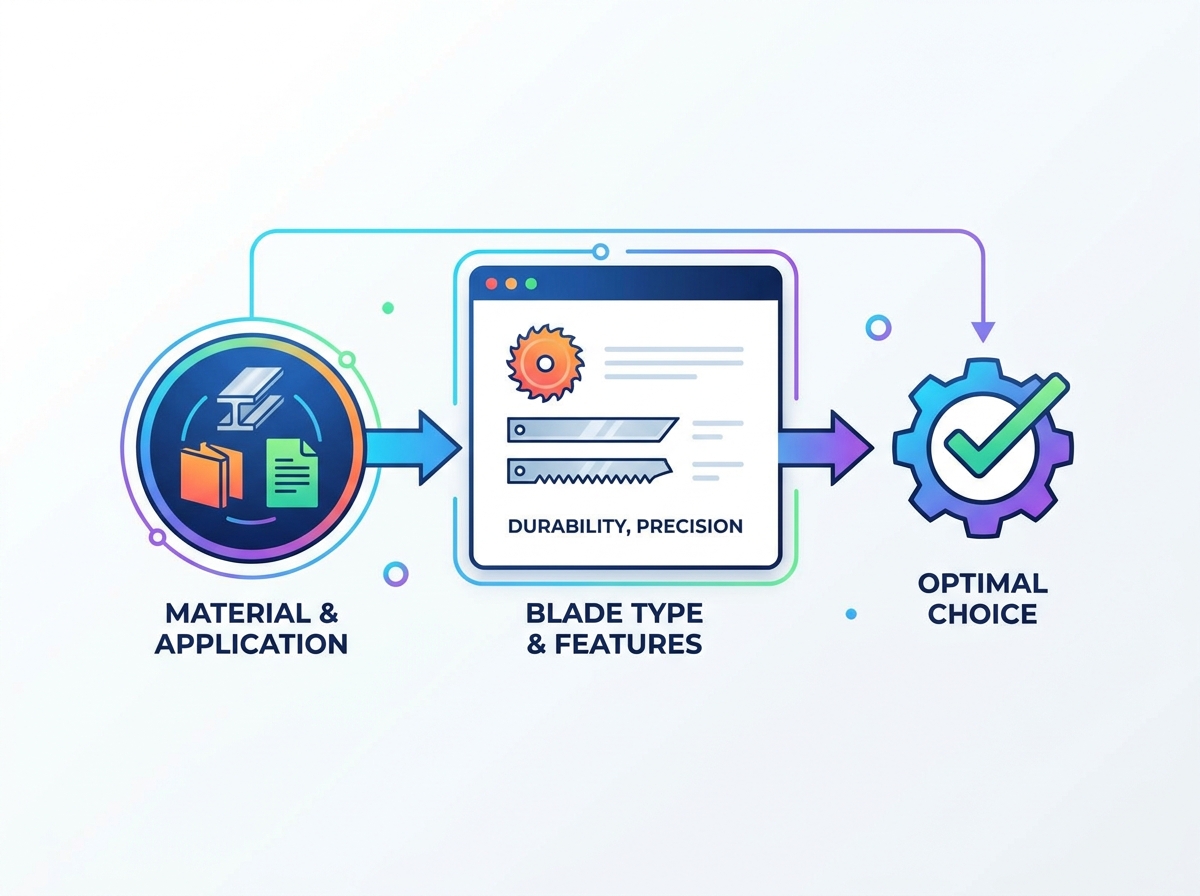
Tooth pitch, measured in Teeth Per Inch (TPI), dictates how aggressively the blade engages the material. The universal rule of thumb requires maintaining a minimum of three teeth in the material thickness at all times. If fewer than three teeth engage, the blade snags the material, causing violent vibrations and stripping the teeth from the blade body. If too many teeth engage simultaneously, the cutting pressure drops, and the blade rubs against the material rather than cutting it.
Gullet capacity represents the empty space between each tooth. The gullet must carry the waste chip out of the cut. If you cut thick, dense material with a fine-toothed blade, the small gullets quickly pack with chips. This prevents the teeth from biting into the material, causing extreme friction, overheating, and eventual blade binding. You must match the gullet size to the volume of material removed per tooth.
The bevel angle determines the sharpness and durability of the cutting edge. A single-bevel configuration features an angle ground onto only one side of the blade, leaving the other side perfectly flat. This geometry is ideal for slicing operations where you need a perfectly clean edge on one specific side of the cut, such as in food portioning or precise film slitting. However, single-bevel blades tend to drift toward the flat side during deep cuts.
Double-bevel configurations feature angles ground on both sides, creating a balanced, V-shaped edge. This provides straight, balanced cuts and greater edge durability for high-impact shearing. Specialized tooth geometries further refine performance. The Alternate Top Bevel (ATB) grind alternates the angle of each tooth, creating a shearing action perfect for crosscutting natural woods without splintering. The Triple Chip Grind (TCG) alternates between a flat raker tooth and a chamfered tooth, providing exceptional durability for cutting hard plastics and non-ferrous metals.
The kerf represents the width of the slot cut by the blade. A thin kerf blade removes less material, minimizing waste. This proves highly beneficial when processing exotic woods or high-value metal alloys. Thin kerf blades also require less machine horsepower to drive through the substrate. However, a thin blade body lacks structural rigidity.
A thicker blade body prevents deflection. When cutting dense, thick materials, a thin blade will wander, resulting in a curved or angled cut. A thick blade provides the beam strength necessary to maintain a perfectly straight trajectory under heavy feed pressure. You must evaluate the trade-off between material yield and cut straightness when specifying blade thickness.
Industrial blades do not operate in a vacuum. They must function within the strict parameters of your machinery. The blade must be engineered to withstand the specific rotational speed (RPM) of the equipment. Running a large diameter blade at an RPM exceeding its design limits creates massive centrifugal forces. This causes the blade to warp, flutter, or even shatter mid-operation.
Feed rates and torque dictate how much physical pressure the blade endures. If your machine utilizes aggressive, high-torque automatic feeders, the blade must feature a robust body and impact-resistant tooth geometry to handle the force without deflecting. Mismatching the blade's structural capacity to the machine's torque output guarantees premature tool failure and ruined substrates. You must calculate the exact chip load to ensure the feed rate matches the blade's cutting capacity.
How the blade mounts to the machine directly impacts its cutting accuracy. The arbor size and mounting hole configurations must match perfectly. Even a fraction of a millimeter of play on the arbor shaft introduces runout. Runout is the lateral wobble of the blade as it spins. Excessive runout creates a wider, rougher kerf, destroys manufacturing tolerances, and causes the blade to hammer against the material rather than slice it.
For band saws and thin-kerf circular saws, proper tensioning is mandatory. Tensioning stretches the blade body, providing the rigidity needed to stay straight under load. Incorrect tensioning leads to blade wander, excessive heat buildup, and stress fractures in the steel. You must calibrate your machine's tensioning mechanisms to match the specific requirements of the blade you select. Additionally, integrating proper flood coolant or mist lubrication systems prevents thermal shock and flushes chips away from the cutting zone.
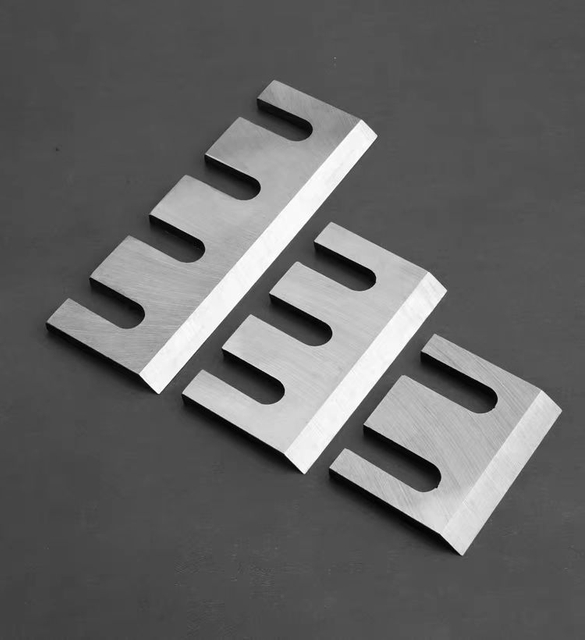
Blades fail early when operators ignore the physical limits of the tool. Incorrect feed rates represent the most common cause of premature failure. Feeding material too fast overloads the gullets and snaps the teeth. Feeding material too slow causes the teeth to rub rather than cut, generating massive heat that destroys the blade's temper and work-hardens the substrate.
Improper break-in procedures also destroy new blades. Band saw blades require a break-in period at reduced feed rates to gently hone the ultra-sharp, microscopic burrs left from the manufacturing process. Forcing a brand-new blade into a full-speed, heavy-feed cut immediately fractures these burrs, leaving you with a dull, chipped edge within minutes of installation. Always match the blade specifications precisely to the material and follow strict break-in protocols.
Industrial blades require proactive maintenance. Running a blade until it completely fails damages your machinery and ruins your product. You must establish predictive maintenance intervals based on production volume and material abrasiveness. Waiting for cut quality to drop before changing the blade is a reactive strategy that guarantees inconsistent manufacturing output.
Implement a routine inspection protocol. Operators must check blades for micro-fractures, missing teeth, and excessive resin buildup. Cleaning the blade surface regularly prevents friction-inducing galling. When a blade shows signs of dullness, remove it immediately for professional resharpening. A properly maintained and timely resharpened blade performs consistently and prevents catastrophic in-cut failures that halt production lines.
Mastering how to choose industrial blades requires a systematic approach. You must eliminate inappropriate options by strictly evaluating material constraints, machine limits, and required cut quality. The substrate dictates the metallurgy, the desired finish dictates the geometry, and the machinery dictates the physical dimensions.
Partnering with an experienced, industry-leading manufacturer makes navigating these engineering trade-offs seamless. With decades of expertise in precision tool engineering and custom blade manufacturing, Hangjin delivers high-performance industrial blades engineered to exact metallurgical and geometric specifications, ensuring maximum operational efficiency and extended tool life for global manufacturing operations.
Take immediate action to optimize your cutting operations by following these steps:
Audit your current production lines to identify specific areas of material waste or frequent tool failure.
Document the exact physical properties, including hardness and abrasiveness, of the substrates you process most frequently.
Consult directly with a specialized tooling engineer to request material-specific sample testing based on your operational parameters.
Implement a strict predictive maintenance and resharpening schedule to prevent catastrophic in-cut failures.
A: The material substrate is the foundational variable. Its hardness, density, abrasiveness, and thermal sensitivity dictate every other decision. These factors determine the required steel grade, surface coating, tooth geometry, and blade thickness needed to achieve a clean cut without damaging the tool.
A: Premature breakage usually stems from improper tensioning, incorrect feed rates, or using the wrong tooth pitch. If fewer than three teeth engage the material, the blade snags and fractures. Failing to properly break in a new blade also causes early micro-fractures.
A: Choose a thin kerf blade when cutting high-value materials where minimizing waste is critical, or when your machine has lower horsepower. Ensure the material is not so dense that it causes the thin blade body to deflect during the cut.
A: Tungsten Carbide offers extreme hardness and exceptional wear resistance, making it perfect for cutting highly abrasive materials like fiberglass or composites. It holds an edge much longer than High-Speed Steel but is more brittle and susceptible to shock.
A: Burning occurs due to excessive friction and heat buildup. This is typically caused by feeding the material too slowly, using a blade with too many teeth that clogs the gullets, or operating a dull blade that rubs rather than shears the substrate.
A: No. Metal requires blades with high structural rigidity, specific rake angles, and heat-resistant metallurgy like HSS. Plastics require sharp, polished edges and heat-dissipating geometries to prevent the material from melting and galling onto the blade body.


